Zeppelin Rush · Genetic AI
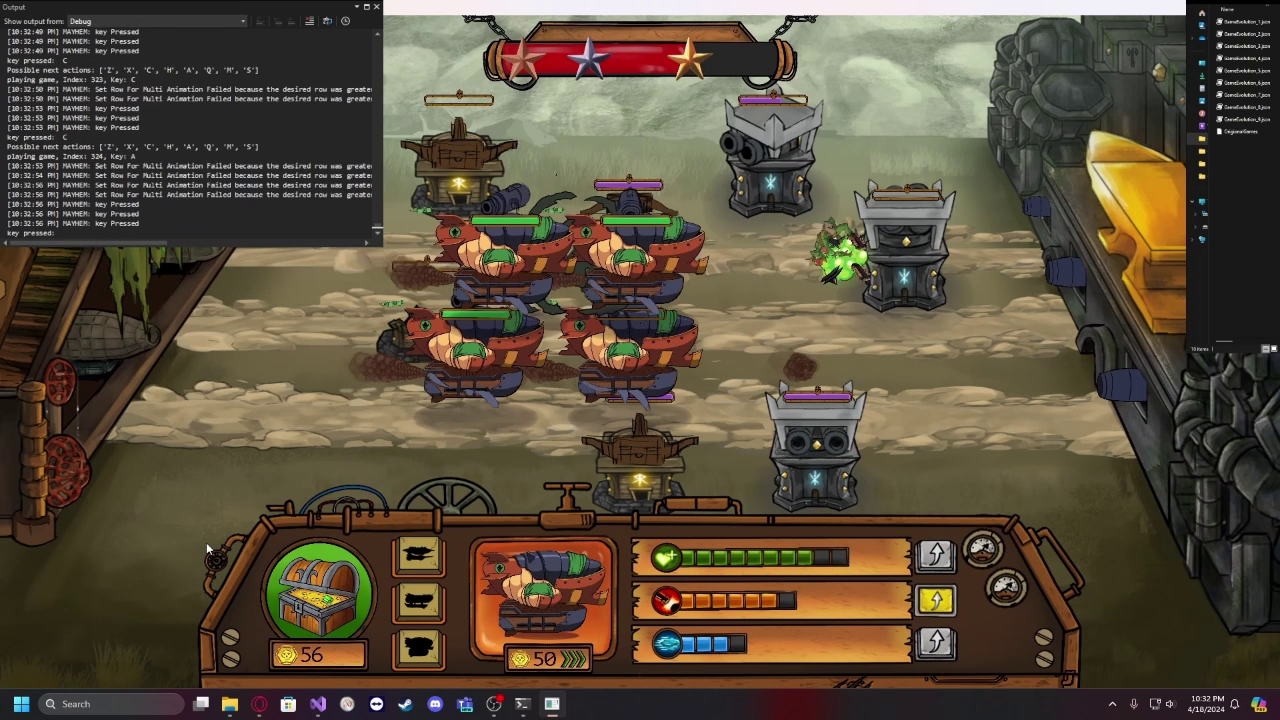
A Python genetic algorithm that learns to win Zeppelin Rush, a tower-offense game on Steam built on Mayhem, the C++ engine my team wrote. In 16 generations it scored 401, past the game's three-star mark. I've earned three stars myself once.
Highlights
- Best game: 401, crossing the three-star threshold of 400. I've done that myself once.
- 60 random starts, 16 generations, about 24 hours of compute.
- Continuous time-remaining fitness (0 to 600) instead of 0 to 3 stars, which gave selection something to choose between.
- FixMutation repair keeps every evaluated individual playable. Illegal moves get rewritten to legal ones before fitness runs.
- JSON IPC with Windows file-lock retry, with no gameplay refactor.
- Per-generation JSON output: any specific game can be replayed in-engine, and the scatter plot rebuilt straight from the files.
- Built before AI coding assistants were useful. I worked out the fitness design, the IPC approach, and the repair pass myself.
Stack
Problem
A genetic algorithm depends on its fitness function. Zeppelin Rush's built-in score is 0 to 3 stars, which is too coarse to drive evolution: two losing games both score zero, so selection can't choose between them. Before any mutation could help, the fitness function had to tell 'lost in 20 seconds' from 'nearly won', and 'barely won' from 'three-star finish'.
Approach
Fitness. Use time remaining on win (0 to 600, higher is better) instead of the 0/1/2/3 star bands. Losses map to a large negative. Every game now gets a different score, running from 'lost slowly' through 'barely won' to 'three-star finish', so selection always has something to choose.
Fitness: time remaining on win, negative on loss12 linespython
def fitness(game_result: dict) -> float:
    """
    game_result is parsed from SharedData.json after the game ends.
    Winning is rewarded by how much time was left (0..600 seconds).
    Losing is a large negative so the GA always prefers any win over
    any loss, but still gradients between 'lost fast' and 'lost slow'.
    """
    timer = game_result["Timer"]       # seconds left when game ended
    state = game_result["Gamestate"]   # "Win" or "Lose"
    if state == "Win":
        return timer                   # higher = finished faster
    return -600.0 + timer              # still a gradient between losses
I/O. The game was mouse-driven. I remapped its inputs onto keyboard keys (T, R, S/M/L, H/A/Q, Z/X/C) and drove it from Python via the keyboard library. Keystrokes are faster and more reliable than screen-grabbing coordinates. Data comes back through SharedData.json: the engine writes gold/gamestate/timer continuously, the Python side polls. Shared memory would have meant rewriting too much of the engine's gameplay code. Windows file locking handled synchronization: if a read landed mid-write, the IOError was caught, the Python code slept a millisecond, and retried.
SharedData.json read loop with Windows file-lock retry9 linespython
def read_game_state(path="SharedData.json", max_retries=50):
    for _ in range(max_retries):
        try:
            with open(path, "r") as f:
                return json.load(f)["GameInfo"]
        except (IOError, json.JSONDecodeError):
            # Engine is mid-write. Back off one tick and retry.
            time.sleep(0.001)
    raise RuntimeError("SharedData.json never settled")
Repair pass. Mutation and crossover regularly produce illegal sequences (selecting the same zeppelin twice in a row, upgrading past the two-upgrade cap). FixMutation walks the action list and rewrites each illegal move into a random spawn, so every game the GA plays is legal and no generations are wasted on dead moves.
FixMutation: constraint-aware repair of illegal sequences28 linespython
SELECT  = {"S", "M", "L"}
UPGRADE = {"H": "health", "A": "attack", "Q": "speed"}
SPAWNS  = ["Z", "X", "C"]   # top / middle / bottom lane

def FixMutation(actions):
    fixed = []
    selected = "S"                                   # small by default
    upgrades = {z: {"health": 0, "attack": 0, "speed": 0}
                for z in SELECT}

    for a in actions:
        if a in SELECT:
            # Illegal: two selects in a row. The previous select was
            # pointless, so replace THIS one with a random spawn.
            if fixed and fixed[-1] in SELECT:
                fixed.append(random.choice(SPAWNS)); continue
            selected = a
            fixed.append(a)
        elif a in UPGRADE:
            stat = UPGRADE[a]
            # Illegal: upgrading past the 2-upgrade cap.
            if upgrades[selected][stat] >= 2:
                fixed.append(random.choice(SPAWNS)); continue
            upgrades[selected][stat] += 1
            fixed.append(a)
        else:
            fixed.append(a)
    return fixed
Outer loop. 60 randomly-played starting games, then 16 evolution steps. Each step selects the top 4 by fitness, runs single-point crossover on the top pair, applies 8-action-flip mutations to the best individuals, plays every new individual in-game, and carries the top 4 through unchanged (elitism), so the best run so far is never lost.
Crossover + mutation on action lists14 linespython
ACTIONS = ["M", "L", "H", "A", "Q", "Z", "X", "C"]

def crossover(p1, p2):
    idx = random.randrange(1, min(len(p1), len(p2)))
    child1 = p1[:idx] + p2[idx:]
    child2 = p2[:idx] + p1[idx:]
    return FixMutation(child1), FixMutation(child2)

def mutate(genome, flips: int = 8):
    g = list(genome)
    for _ in range(flips):
        i = random.randrange(len(g))
        g[i] = random.choice(ACTIONS)
    return FixMutation(g)
Figures
Why these choices
- Python + `keyboard` library
- Injecting keystrokes was simpler and more reliable than screen-grabbing and mouse simulation. The engine got a one-time keyboard remap, and after that the GA didn't depend on engine internals.
- SharedData.json + Windows file locking
- Shared memory would have meant a large engine refactor. A JSON file plus a `try/except IOError` let the OS file lock handle synchronization, and gameplay code stayed as it was.
- FixMutation (constraint-aware repair)
- Mutation and crossover regularly produce illegal sequences (double-select, over-upgrade). The repair pass rewrites them into legal moves, so every game the GA plays is legal.
- Elitism (top 4 carried unchanged)
- Keeps the best games even if all their offspring mutate into something worse, so the best score never drops.
- Mayhem Engine (C++, built with my team)
- Because we wrote the engine, I could add the keyboard remap and the JSON output on the game side directly.